Learning One's Native Tongue: Citizenship, Contestation, and Conflict in America by Tracy B. Strong
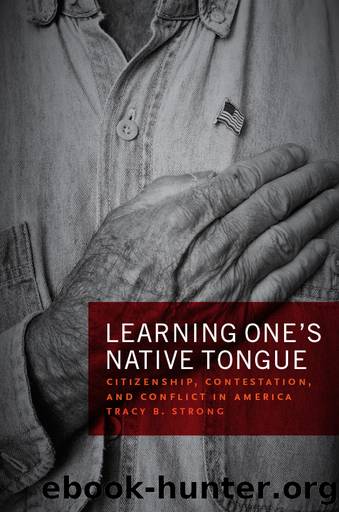
Author:Tracy B. Strong [Strong, Tracy B.]
Language: eng
Format: epub
ISBN: 9780226623221
Google: JCi7DwAAQBAJ
Goodreads: 43819474
Publisher: University of Chicago Press
Published: 2019-01-15T10:37:30+00:00
WHAT WERE THE CHANCES FOR POLITICAL SUCCESS?
By the first decade of the twentieth century, Seattle, Washington, was one of the most progressive cities in America. With the defeat of populism and Western silver, it had become a focus for progressives seeking new opportunities. As noted previously, various utopian and semiutopian communitiesâthe Brotherhood of the Cooperative Commonwealthâwere established around Puget Sound.31
In addition to the utopians, more practical socialists of all persuasions flocked to the Northwest. The state of Washington had dozens of socialist newspapers. The 146th issue of the Socialist urged its readers to âJoin the Party of Your Classâ and carried as its cover page a bare-chested male worker swatting away the âparasitesâ with a hand on which was written âYour Union.â Since the turn of the twentieth century, young industries and a new workforce, much of it of Scandinavian extraction, had made the West a fertile organizing ground for the IWW and other unions. The Seattle workforce was close to 100 percent unionized. On May 1, 1916, the International Shingle Weaversâ Union, a member of the craft union organization, the American Federation of Labor, had called a strike throughout the Northwest. By August of that year, the strike had either been won or called off in almost every city except Everett, Washington, the home of the Jamison Mill. Shingle weaving was among the most dangerous of jobs: the workers had constantly to reach around the cutting blades to turn the shingles so that they were cut evenly on all sides. If the weaver did not catch cedar asthma from the dust that penetrated even the sponge tied over his mouth, it was only a matter of time until he lost a hand or even an arm to the whirling saws. On August 1, a group of thugs hired by the Jamison Mill savagely beat with ax handles the eighteen picketers walking the line. Shortly thereafter, the police in Everett began to enforce an âordinanceâ passed by the city council prohibiting speechmaking downtown. As noted, since the earliest days of the labor movement, free-speech questions and the positive civil right to address groups in public had been essential issues to the unions as a practice essential to citizenly activity. The Everett ordinance was tantamount not only to shutting down union organizing but also to denying the groups an essential part of their being as citizens. With this action, the IWW joined forces with the Shingle Weaversâ union.
This is the background for what became known as âBloody Sunday,â November 5, 1916, the Everett Massacre.32 The IWW called a rally in Seattle for two in the afternoon, and the assembled crowd marched to the docks and boarded the steamer Verona for the thirty-mile trip up the bay to Everett. As the steamer approached the shore, the passengers could see only three men assembled on the dock. A collective vision rang out in song from the boat:
Download
This site does not store any files on its server. We only index and link to content provided by other sites. Please contact the content providers to delete copyright contents if any and email us, we'll remove relevant links or contents immediately.
The Vikings: Conquering England, France, and Ireland by Wernick Robert(84383)
Ali Pasha, Lion of Ioannina by Eugenia Russell & Eugenia Russell(40318)
The Conquerors (The Winning of America Series Book 3) by Eckert Allan W(37983)
The Vikings: Discoverers of a New World by Wernick Robert(37006)
Cecilia; Or, Memoirs of an Heiress — Volume 1 by Fanny Burney(32636)
Cecilia; Or, Memoirs of an Heiress — Volume 2 by Fanny Burney(32010)
Cecilia; Or, Memoirs of an Heiress — Volume 3 by Fanny Burney(31996)
Empire of the Sikhs by Patwant Singh(23135)
The Secret History by Donna Tartt(19297)
Hans Sturm: A Soldier's Odyssey on the Eastern Front by Gordon Williamson(18650)
Cat's cradle by Kurt Vonnegut(15443)
Pimp by Iceberg Slim(14667)
Sapiens: A Brief History of Humankind by Yuval Noah Harari(14461)
Norse Mythology by Gaiman Neil(13458)
Talking to Strangers by Malcolm Gladwell(13440)
Leonardo da Vinci by Walter Isaacson(13411)
4 3 2 1: A Novel by Paul Auster(12513)
Underground: A Human History of the Worlds Beneath Our Feet by Will Hunt(12145)
The Radium Girls by Kate Moore(12094)
